A Brief Note on the Age Dynamics of the 2025 German General Election
Published: 03 Mar 2025
Tag: Political Science
A small update this time. I’m still digesting much of the recent news and trying to work out what, if anything at all, I might write about it here or on substack. In the meantime, I’ve been playing around a little with the exit polls from the recent general election in Germany.
The Age Divides
At this point, the age divides in the election have been widely reported. Namely: Die Linke came first among the youngest voters and the AfD came second. There is a clear gender divide: support for Die Linke was largely driven by women. The CDU/CSU and SPD meanwhile did best among older voters. You can see most of this in the plot below, for which I used data from the Infratest dimap exit poll1:
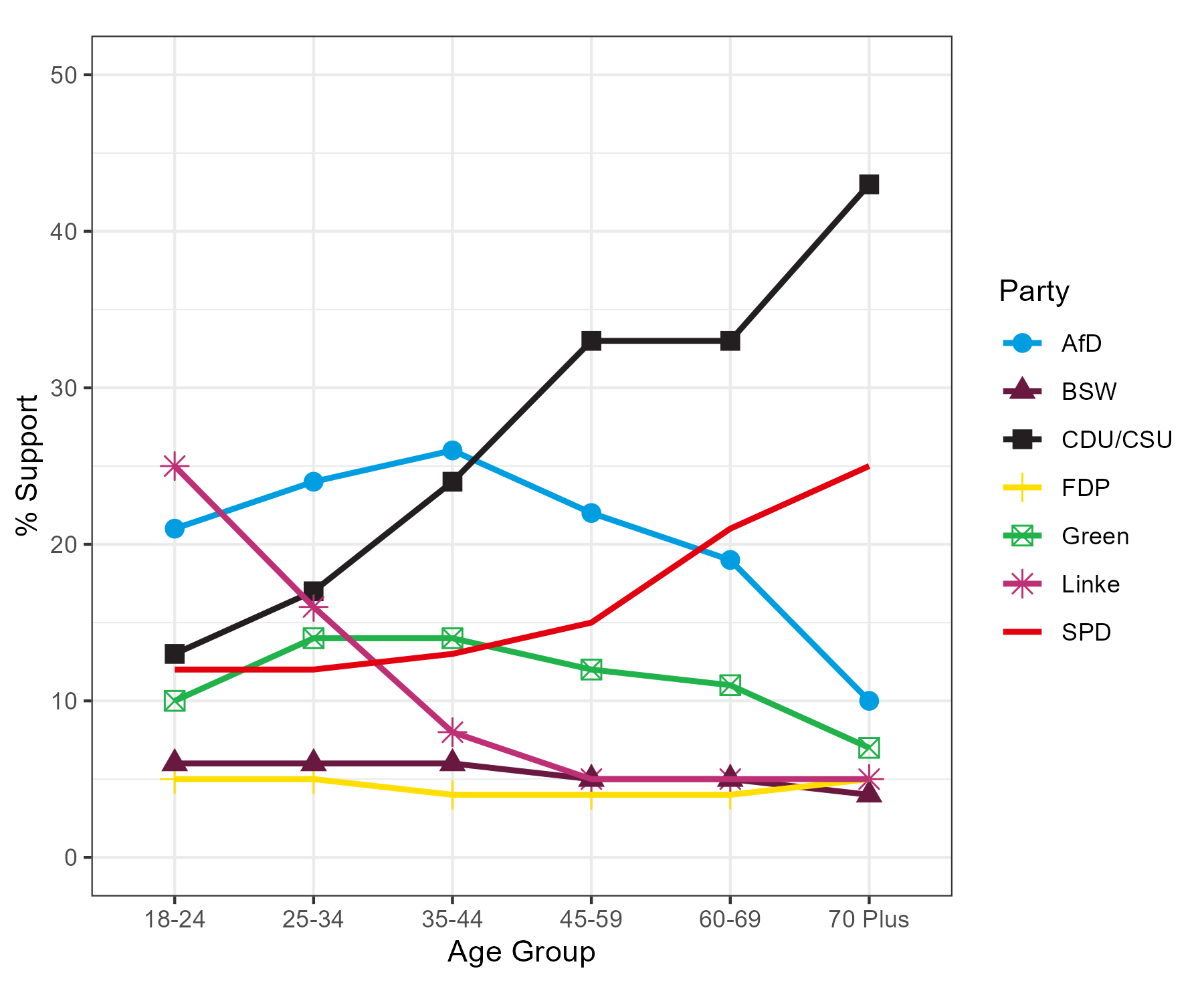
There is, basically, a straightforward relationship between age and support for the SPD (positive), CDU/CSU (positive), and Die Linke (negative). There is no descriptive relationship for the FDP or the BSW. The Greens and AfD have a non-linear relationship with age, peaking among the 25-34 and 35-44 age groups. The AfD has seen a larger drop-off among the oldest voters.
Disentangling the Divides
I find these age dynamics interesting. A common political stereotype is that increased age should be associated with increased conservatism/right-wing politics. For example, the quote “If you’re not a liberal when you’re 25, you have no heart. If you’re not a conservative by the time you’re 35, you have no brain” is commonly attributed to Winston Churchill, who was a Conservative at 25 and a Liberal at 35. Presumably the attributors looking to justify their own rightwards drift over their lives do not realise they are suggesting Churchill had neither heart nor brain.
But in Germany, the AfD does better with young voters than it does older voters, despite being by some distance the most right-wing party in German politics. But then so too does Die Linke. And while support for the CDU/CSU fits this stereotype, support for the SPD does not. What I think is going is two different things. First, if we aggregate support for all the left parties (SPD, Greens, Die Linke), and support for all the right parties (CDU/CSU, FDP, AfD), we can see whether the basic relationship between left and right holds up. I didn’t include the BSW in either side because I have no idea how a left-authoritarian party should be classified in this simplistic schema:
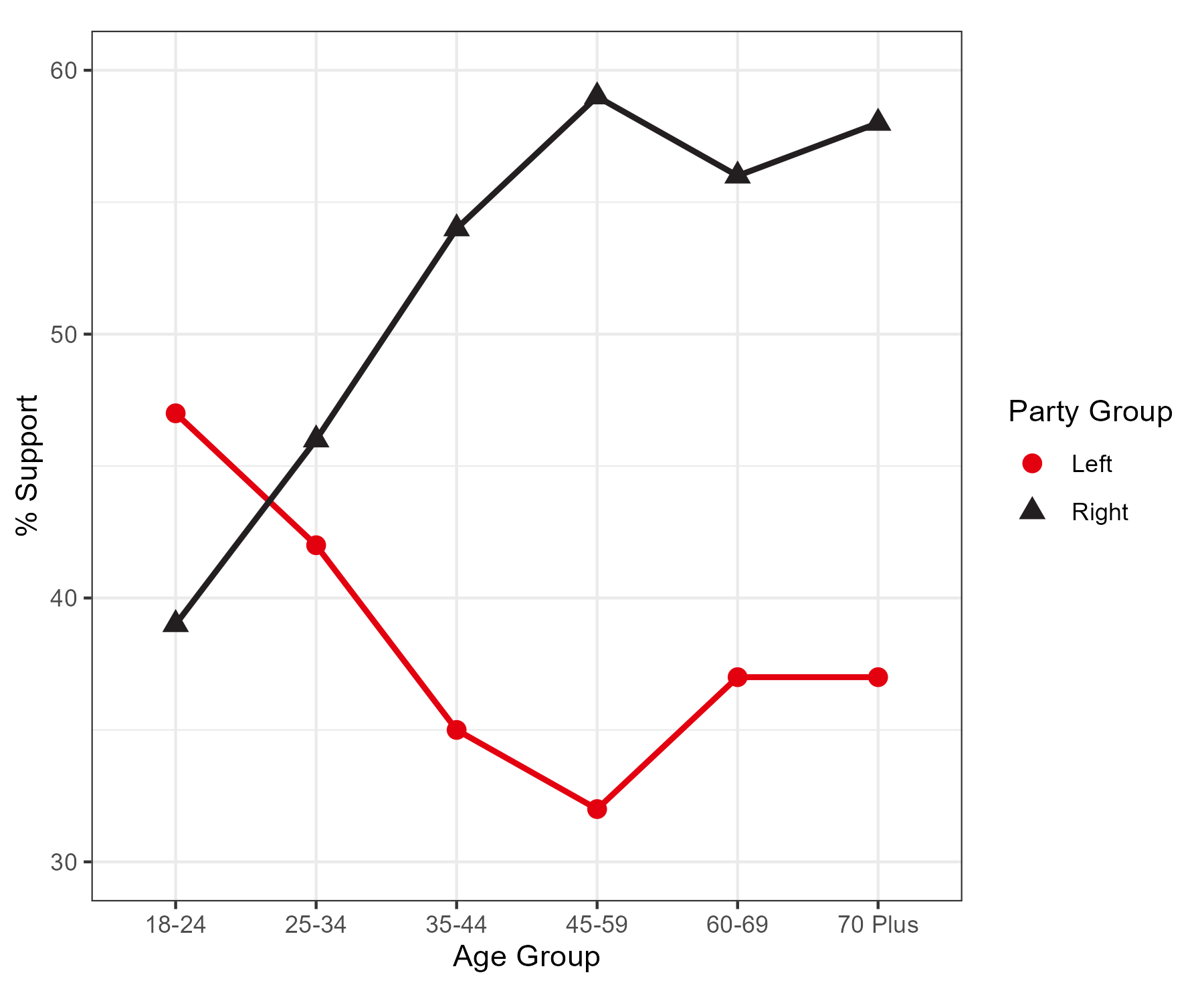
In short, it sort of holds up, at least from the 18-24 age group to the 45-59 age group. Weirdly, the 60-69 and 70+ age groups look more like the 35-44 age group. I don’t really know why this is. But they’re still much less left-wing than the youngest age groups, which is probably the main thing to take from here.
The next thing I looked at is the composition of the left-wing and right-wing votes in the election. Basically, I took the percentage each party represents of its grouping. For example: for the Greens I took the percentage of left-wing votes in that age group going to the Greens; while for the CDU/CSU I took the percentage of right-wing votes going to the CDU/CSU. The results are below:
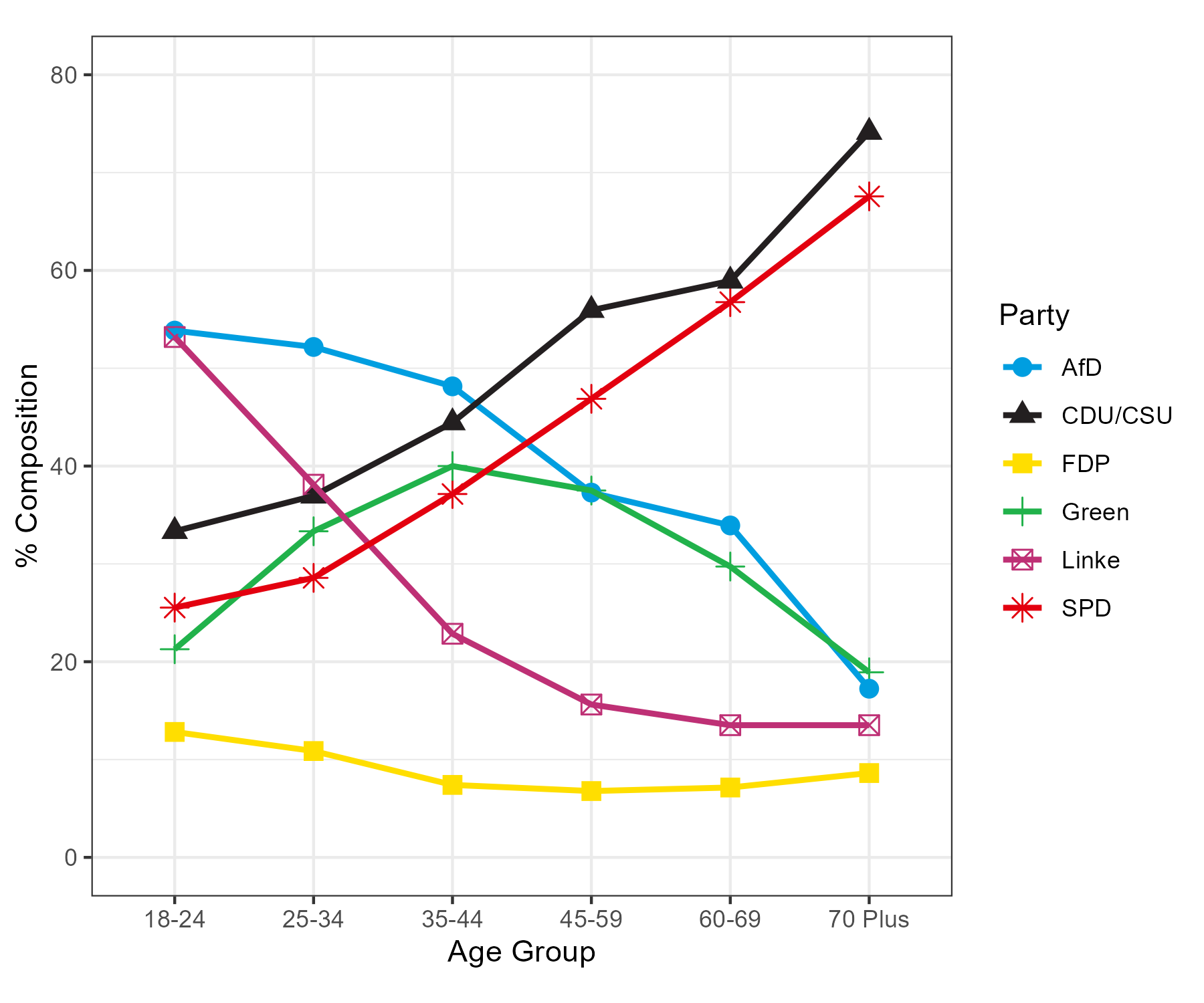
Here the most straightforward trends emerge. Among the youngest voters, if you are left-wing you are most likely to vote for Die Linke, and if you are right-wing you are most likely to vote for the AfD. Since young people vote for left-wing parties more so than right-wing ones, Die Linke beats the AfD. Among the oldest voters, if you are voting for a left-wing party it is most likely to be the CDU/CSU, and if for a left-wing one it is most likely to be the SPD. Hence the SPD does best among the oldest voters, even though the oldest voters are less likely to vote for left-wing parties than younger voters.
Notably, although the 45-59 age group votes right-wing the most, the AfD does best among the 35-44 age group because of the trade-off between an increasing right-wing vote and decreasing proportion of the right-wing vote going to the AfD.
Some Thoughts
I don’t know what to make of these trends. I don’t have the knowledge necessary: one would need expertise in German politics to explain these further.
I do know that some competing explanations could exist. One is in terms of generational replacement, or cohort effects. Basically: members of particular generations are socialised by their early views/circumstances/whatever, and then hold fairly consistent views. It is easier for young voters to start voting Die Linke or AfD than it is for older voters, who are more ingrained in their voting habits and the parties they are willing to consider.
There’s good reason to suspect this is the case. Past work has suggested that cohort effects towards voting for radical right and green parties exist2, and that newer cohorts consider voting for a larger set of parties than older cohorts3. But cohort effects are not the same thing as descriptive differences between cohorts4.
The open question is how much this will interact with the typical life-trajectory towards the political right. If young voters supporting Die Linke now do eventually drift right, will it be towards the AfD, or elsewhere? Or will they even drift right at all, given the extremism of the AfD? I honestly have no idea.
One thing I haven’t explored here is the gender dynamics of all of this. It’s now known, if not as widely reported as it should be, that the swing to Die Linke among younger voters was driven by women5. If memory serves, all of this mirrors the basic patterns around Reform and Green support in the UK. Younger UK voters on average do not vote right, but if they do they vote Reform. But this is largely driven by young men, and not young women.
It’s plausible that young German women will remain to the left of men of the same generation for the rest of their lives. There is also evidence for this in terms of cohort effects6. Notably, in the same evidence older women tend to be ceteris paribus to the right of older men: I would not be surprised if a similar dynamic held with CDU/CSU and SPD support among the old.
Coda
If you want to understand the meaning of all of this for German politics/Europe, I suggest turning to people other than me. German politics is interesting to me, and I know a little more than the typical layperson, but it is firmly not my area of expertise. To this end, I wish to conclude by simply directing you to the analysis of the Guardian expert panel, which includes a range of experts including political scientists:
Germany has swung to the right. What does that mean for the country – and Europe? Our panel responds
Footnotes
-
https://www.tagesschau.de/wahl/archiv/2025-02-23-BT-DE/umfrage-alter.shtml ↩
-
Mitteregger, R. (2024) Socialized with “old cleavages” or “new dimensions”: An Age-Period-Cohort analysis on electoral support in Western European multiparty systems (1949–2021), Electoral Studies 84. DOI: https://doi.org/10.1016/j.electstud.2024.102744 ↩
-
Mitteregger, R. (2024) Overlooked de- and realignment? Cohort differences in consideration sets, West European Politics 48 (4). DOI: https://doi.org/10.1080/01402382.2024.2412477 ↩
-
A personal pet peeve is reporting of APC analysis results which fail to respect this distinction. A cohort effect for some generation will be written up as if a description of the ideological position of the generation - something we can know without an APC analysis. ↩
-
I can’t find the link for this anymore and this is not an academic article so you’ll have to take my word for it. Sorry. ↩
-
Shorrocks, R. (2018) Cohort Change in Political Gender Gaps in Europe and Canada: The Role of Modernization Politics & Society 46 (2). DOI: https://doi.org/10.1177/0032329217751688 ↩